
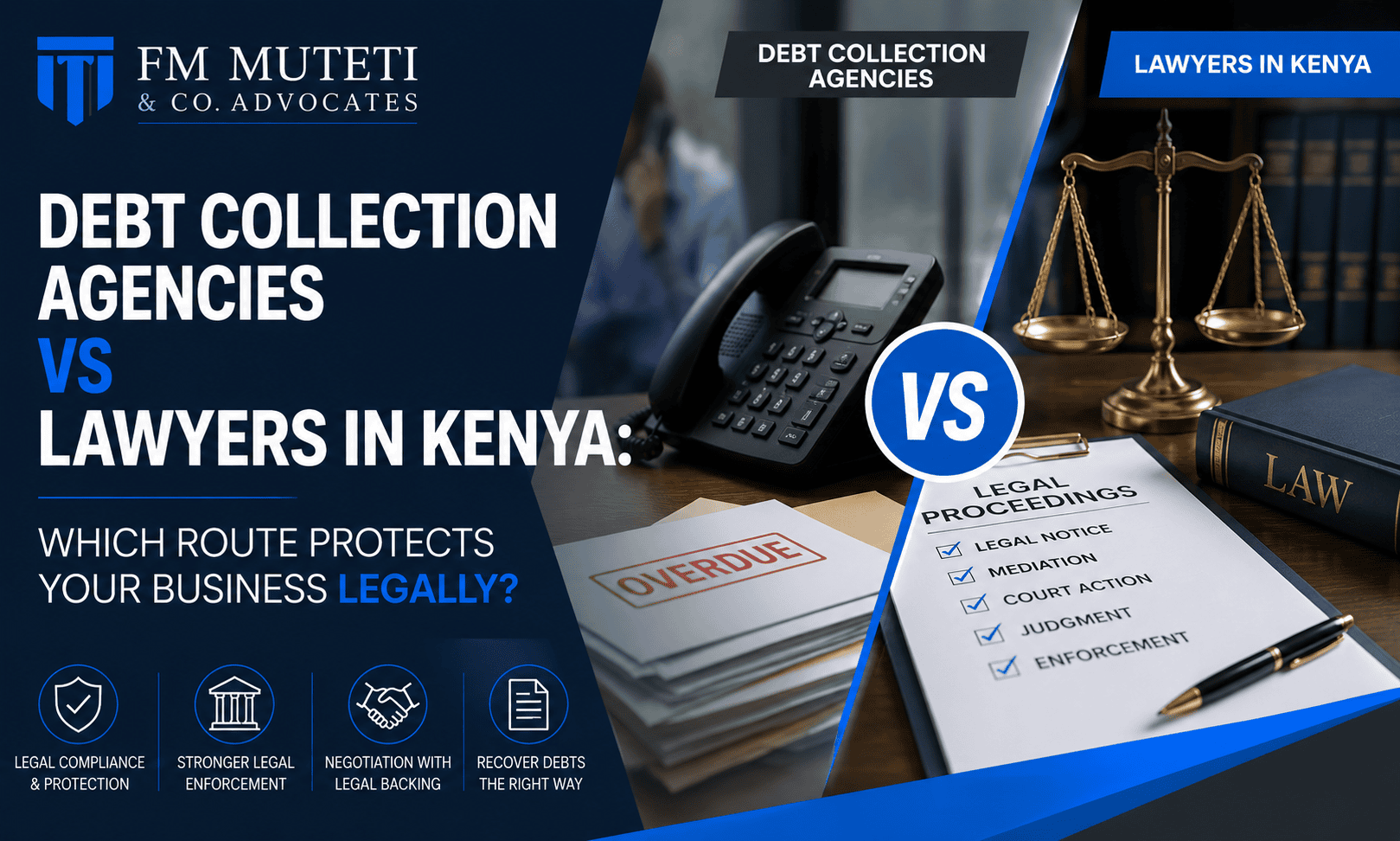
When a business is owed money, the priority is usually simple: get paid.
The route chosen to recover that money can affect the cost of recovery, how the debtor is approached and what happens if the debtor still does not pay. A debt collection agency may assist with routine follow-up and negotiation, while a lawyer can assess the legal position, issue a demand and take the matter into formal proceedings where necessary.
For a business choosing between a debt collection agency and a lawyer in Kenya, the key question is which approach provides the right level of legal protection for the situation.
What Does a Debt Collection Agency Do?
A debt collection agency is generally engaged to pursue payment on behalf of a creditor.
Depending on the arrangement, this may involve contacting the debtor, sending collection communications, following up on overdue accounts and negotiating payment.
What Does a Lawyer Do in Debt Recovery?
A lawyer can assist with debt recovery by assessing the claim and supporting evidence, issuing a demand, negotiating with the debtor and handling court proceedings where necessary.
Legal assistance becomes particularly important when the debtor disputes the debt, the contractual position is unclear or informal collection efforts have failed. Advocates may also undertake non-contentious debt collection work, including issuing demand letters, under the applicable fee rules.
Debt Collection Agency vs Lawyer in Kenya: What Is the Difference?
The main difference lies in the range of legal work available when a debt becomes disputed or requires formal enforcement.
| Debt Collection Agency | Lawyer |
| Usually focuses on pursuing payment | Can pursue payment and provide legal advice |
| May contact the debtor and negotiate payment | Can review the legal basis and evidence supporting the debt |
| Suitable for some straightforward accounts | Can advise where the debt is disputed or legally complex |
| May resolve a debt without court action | Can advise on and handle formal court proceedings where appropriate |
| May need to hand the matter over if formal legal proceedings become necessary | Can advise on litigation, judgment and enforcement |
| Useful for outsourced routine collection | Useful where legal rights, procedure or enforcement are central to recovery |
When Is a Debt Collection Agency Appropriate?
An agency is suitable where the debt is straightforward, the documentation is in order and the business mainly needs help following up on overdue accounts.
It can also make sense where a business has multiple unpaid accounts and wants to outsource routine collection instead of having its staff handle every debtor.
Before appointing an agency, understand its fees, collection methods, authority to negotiate and escalation process if the debtor refuses to pay.
When Should a Business Involve a Lawyer?
A lawyer is appropriate where the debt is disputed, the contractual position is unclear or court proceedings are necessary.
A lawyer can assess whether the business has an enforceable claim, whether the evidence supports the amount demanded and which recovery procedure is appropriate.
Legal advice is also important where enforcement is required, since obtaining judgment does not automatically result in payment.
What About Harassment During Debt Collection?
Debt recovery must comply with the law and any specific rules governing the creditor or collection arrangement.
Some regulated sectors have specific restrictions on debt-collection conduct. For example, regulations governing SACCOs restrict appointed debt collectors from harassing, oppressing or abusing people in connection with debt collection. They also address threats, obscene language and false or misleading representations.
Similar restrictions apply to digital credit providers under the Central Bank of Kenya regulatory framework.
These rules do not automatically apply to every commercial debt collection agency in Kenya. The protections that apply depend on the type of creditor, the nature of the credit and the regulatory framework governing it.
For an ordinary business-to-business debt, the creditor and its collection agent should ensure that recovery methods comply with the law.
What Should You Check Before Hiring a Debt Collection Agency?
Before appointing an agency, consider:
- Identity and authority: Confirm who the agency is and the basis on which it will act for your business.
- Fees: Understand how the agency charges and whether additional costs may arise.
- Collection methods: Ask how it communicates with debtors and what safeguards it has against improper conduct.
- Information handling: Establish how confidential business and debtor information will be handled.
- Escalation: Find out what happens if the debtor disputes the claim or refuses to pay.
Also confirm what regulatory requirements apply to the agency and the debt it will be collecting. An agency describing itself as a debt collector should not automatically be assumed to hold a general Central Bank of Kenya licence for debt collection. CBK regulates specific categories of financial institutions and credit providers, so the applicable requirements depend on the institution and type of credit involved.
Which Debt Recovery Route Is Right for Your Business?
The right choice depends on the debt, the evidence available and the stage of recovery.
An agency suits straightforward accounts where the immediate need is outsourced collection. A lawyer is more appropriate where the debt is disputed, the legal position requires assessment, or court proceedings and enforcement are likely to be necessary.
In some cases, both can form part of the recovery process at different stages. A business may begin with collection efforts and seek legal advice if the debtor refuses to pay or raises a substantive dispute.
If you are unsure which route to take, a debt recovery lawyer can review the debt and supporting documents and advise on the next step. Our Debt Collection Law team can assist with demand letters, negotiations, court proceedings and enforcement where necessary.
Frequently Asked Questions
Is a debt collection agency cheaper than a lawyer?
The cost depends on the debt, services required and whether the matter proceeds beyond initial collection efforts. A lower initial fee does not necessarily mean lower total recovery costs.
Can a lawyer send a demand letter for an unpaid business debt?
Yes. Advocates may undertake non-contentious debt collection work, including issuing demand letters. Different fee provisions may apply if court proceedings are later instituted.
What happens if a debtor disputes the debt after an agency has been appointed?
Review the nature of the dispute and the supporting documents. If the dispute raises contractual, evidential or legal issues, legal advice can help determine the appropriate next step.
What should I do if a debt collector is harassing my business or customer?
Keep records of the communications and conduct involved and seek legal advice where necessary. The protections available will depend on the circumstances and, where relevant, the regulatory framework governing the debt.