
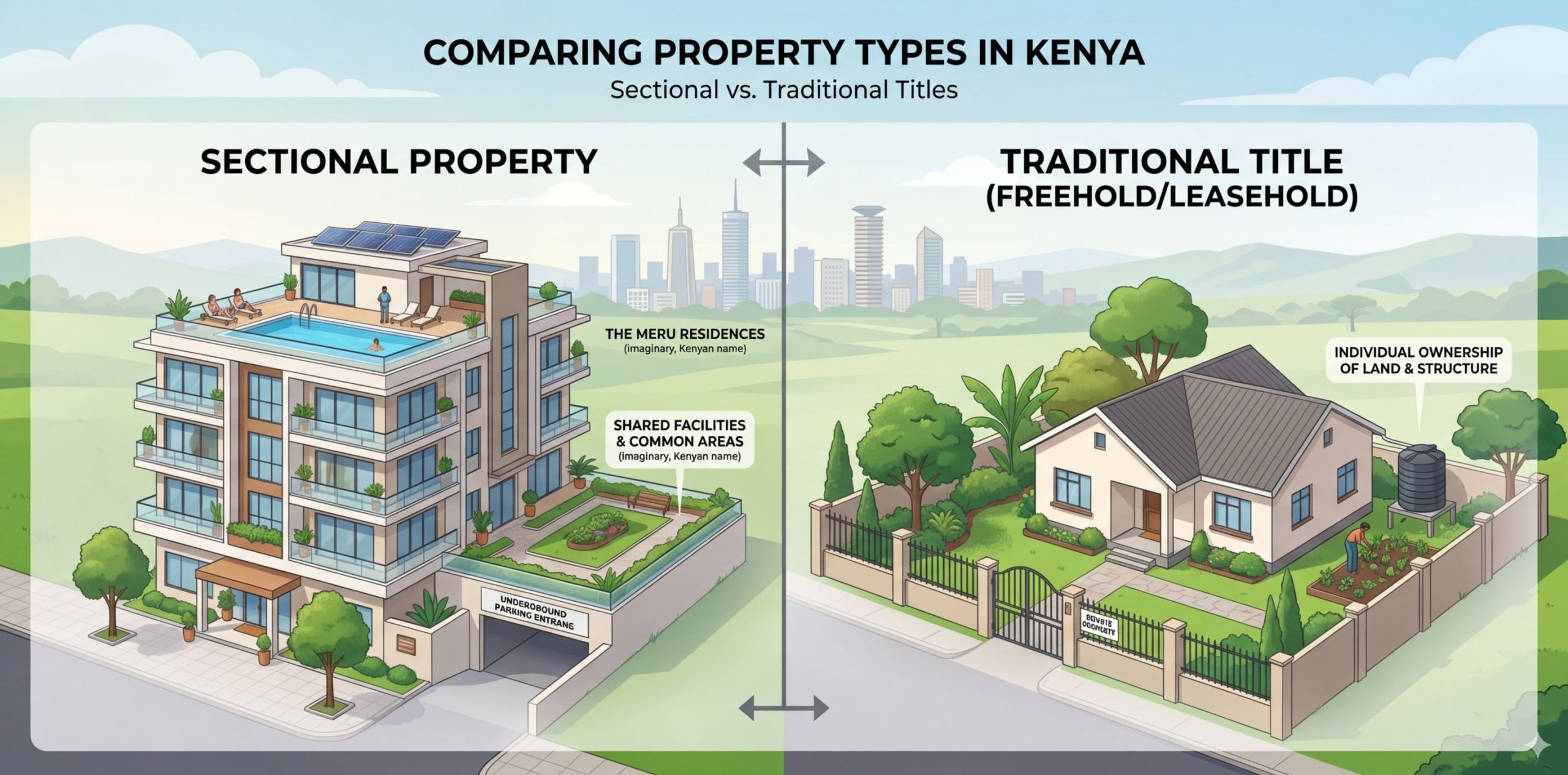
In Nairobi’s fast-moving property market, understanding sectional property vs traditional titles is critical for risk-aware investors. Sectional property is established on the underlying mother title, dividing a building into individually owned units, while traditional titles confer sole ownership of an entire parcel. Both carry distinct regulatory and financial exposures. Non-compliance with the Sectional Properties Act, 2020, including failure to close the mother title, can trigger registration delays, disputes, or unintended encumbrances.
Transactions reviewed by F.M. Muteti & Co. Advocates frequently reveal a recurring pattern: misalignment between intended use and legal structure is the primary source of risk. Even a fully compliant sectional plan cannot secure ownership if the mother title is incomplete. Investors must assess control, flexibility, and long-term liability carefully before committing substantial capital.
In practice, the choice hinges on risk priorities. Investors seeking unambiguous control generally prefer traditional titles. Those valuing flexibility or unit-level investment may find sectional property appropriate. Early clarity prevents disputes and secures smoother registration outcomes.
Legal Framework Governing Sectional and Traditional Titles
Traditional titles are governed by the Land Registration Act, 2012, while sectional property is regulated under the Sectional Properties Act, 2020. These statutes define ownership rights, registration obligations, and compliance thresholds. Transactions reviewed by F.M. Muteti & Co. Advocates indicate that failure to properly register the mother title or obtain sectional plan approval remains the primary source of enforceability risk. Meeting statutory requirements is essential to secure legally enforceable property rights and prevent disputes during transfer or resale.
Procedures for Sectional and Traditional Property Transfers
For sectional property, statutory steps include preparing an approved sectional plan, obtaining consent from the mother title holder, and registering individual units at the Land Registry. Traditional titles follow standard survey and registration procedures. Only official channels, such as the Land Registry and county approvals, are recognized.
In practice, transactions reveal a consistent pattern: incomplete documentation or informal shortcuts create downstream disputes. Even a single overlooked step can delay registration or complicate enforcement. Closely observing statutory processes mitigates these risks and supports smoother ownership transfer.
Transaction and Transfer Considerations
Transferring sectional property in Kenya requires strict compliance with the Sectional Properties Act. Statutory charges, required consents, and registration obligations must all be observed. For traditional titles, transfers focus on verifying encumbrances, clearing statutory dues, and registering the transaction under the Land Registration Act.
In practice, delays frequently occur where the mother title remains unclosed or the sectional plan does not meet compliance thresholds. Recognition of these structural dependencies early in the transaction helps reduce exposure and supports smoother registration outcomes for any sectional property title in Kenya.
Cost Exposure in Sectional and Traditional Property Transactions
Costs vary depending on transaction complexity and compliance status.
Common categories include:
- Legal fees for due diligence and document preparation
- Stamp duty and registration charges
- Surveyor or sectional plan approval fees
Additional costs may arise if compliance gaps are identified. In sectional property transactions, unapproved plans or incomplete registration of the mother title can trigger extra approvals or corrective steps. Early identification of these issues generally reduces unexpected financial exposure.
Common Pitfalls in Sectional and Traditional Property Transactions
Recurring risk points include:
- Incomplete mother title
- Unapproved sectional plans
- Undisclosed encumbrances
- Conflicting property records
- Misfiled registration documents
- Non-compliance with Sectional Properties Act thresholds
Role of Lawyers in Sectional and Traditional Property Transactions
Legal oversight in property transactions functions as structured risk control rather than procedural support. The focus is on verifying compliance, identifying exposure, and ensuring that ownership rights are enforceable at registration.
Key responsibilities include:
- Title verification and encumbrance checks
- Review of sectional plans and approvals
- Monitoring statutory compliance
- Mitigating registration disputes
In practice, issues frequently arise where the mother title remains unclosed or compliance thresholds under the Sectional Properties Act are overlooked. Early identification of these risks supports clearer transaction structuring and reduces the likelihood of delayed or contested registration.
Transactions involving sectional and traditional property require alignment between statutory requirements and the investor’s intended use. This is particularly relevant where control, shared ownership, or long-term liability considerations differ between structures. Approval and registration processes follow statutory requirements outlined by Ardhisasa and the Land Registry.
Transactions reviewed by the conveyancing team at F.M. Muteti & Co. Advocates in Nairobi reflect the importance of disciplined legal oversight. This oversight helps manage regulatory exposure and secures enforceable ownership outcomes.
Which Structure Fits Your Risk Profile?
The choice between sectional property vs traditional titles should be guided by risk alignment. In practice, investors prioritizing flexibility and shared maintenance frequently adopt sectional property, while those focused on control, clarity, and single-party liability tend to select traditional titles.
Key considerations include:
- Flexibility and shared cost favor sectional property
- Control, unambiguous ownership, and liability clarity favor traditional titles
This approach guides investors by linking each ownership structure to specific risk priorities, without prescribing personal preference.
Common Questions on Sectional Property vs Traditional Titles
What is a sectional property in Kenya?
A sectional property divides a building into individually owned units with shared common areas. In practice, transactions reveal that misalignment between intended use and statutory compliance often causes disputes or delays.
How does traditional title differ?
Traditional title grants sole ownership of an entire parcel of land and any structures on it. Investors prioritizing control, clear liability, and unambiguous ownership generally prefer this structure.
Is mother title closure required for sectional property?
Yes. Proper registration and closure of the mother title are mandatory. Transactions frequently reveal that incomplete closure triggers disputes or delays in unit registration.
Who can assist with sectional property transfers?
Sectional Titles Lawyers in Kenya ensure compliance with the Sectional Properties Act, 2020, and mitigate risks during the transfer process. Their oversight reduces exposure to registration or enforcement issues.
Are there statutory approvals for sectional property?
Yes. Approval of the sectional plan by county authorities and registration at the Land Registry are compulsory. In practice, missing approvals are a common cause of delays or downstream disputes.
What risks should investors monitor in sectional property?
Key risks include incomplete mother titles, unapproved sectional plans, undisclosed encumbrances, and misfiled registration documents. Identifying these early reduces financial and legal exposure.
Can traditional title ownership be challenged?
While traditional titles offer clear control, transactions occasionally reveal encumbrances, conflicting records, or zoning non-compliance that can complicate ownership enforcement.
Final Thoughts on Sectional Property vs Traditional Titles in Kenya
Selecting between sectional property and traditional titles is a question of structural fit, not personal preference. Flexibility favors sectional property; control favors traditional titles. Professional legal review and structured oversight reduce exposure, confirm statutory compliance, and secure long-term ownership.
Investors benefit from measured guidance and experience-backed insight. Transactions reviewed by the property law team at F.M. Muteti & Co. Advocates in Nairobi demonstrate how risk-informed decisions protect both investment and compliance integrity. For practical support, explore how we manage sectional property transactions in Nairobi and align your property decisions with statutory compliance.